In This Article
What Is Road Tax in Thailand?
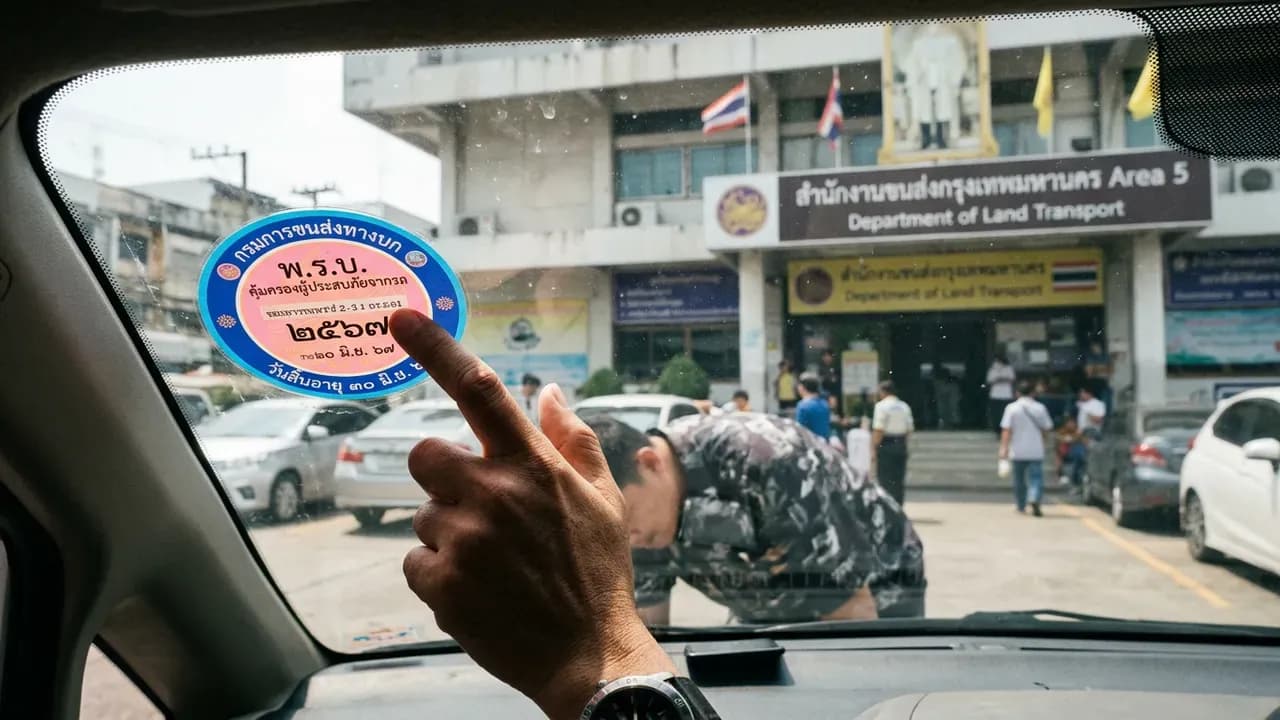
Road tax in Thailand is officially called the annual vehicle registration renewal fee. It is paid every year and is required for all registered vehicles — cars, motorcycles, trucks, and buses. When you pay road tax, you receive a new tax sticker (called a 'tax disc' or por ror bor 4) that must be displayed on the vehicle's windshield (for cars) or carried with the vehicle (for motorcycles). The tax sticker shows the expiration date, and driving with an expired sticker is technically illegal and can result in a fine of up to 2,000 THB. Road tax is separate from the compulsory insurance (Por Ror Bor), but you must have valid compulsory insurance before you can renew your road tax. The renewal period begins 90 days before the expiration date printed on your current sticker. The annual road tax helps fund road maintenance, traffic infrastructure, and the Department of Land Transport's operations.
Car Tax Rates by Engine Size
Road tax for passenger cars (sedans, hatchbacks, SUVs) is calculated based on engine displacement in cubic centimeters (CC). The rates are progressive, in three brackets: for the first 600 CC, the rate is 0.50 THB per CC. From 601 to 1,800 CC, the rate is 1.50 THB per CC. Above 1,800 CC, the rate is 4.00 THB per CC. For example, a typical sedan with a 1,500 CC engine would pay: (600 x 0.50) + (900 x 1.50) = 300 + 1,350 = 1,650 THB per year. A 2,000 CC car would pay: (600 x 0.50) + (1,200 x 1.50) + (200 x 4.00) = 300 + 1,800 + 800 = 2,900 THB per year. Vehicles older than a certain age receive a discount: cars over 6 years get a 10% reduction each year, down to a maximum 50% reduction. Electric vehicles have a separate, lower rate structure.
Motorcycle Tax Rates
Motorcycle road tax is simpler and much cheaper than car tax: private motorcycles pay a flat 100 THB per year regardless of engine size (motorcycles with a sidecar pay 150 THB, and commercial/public motorcycles have their own schedule). That means the most common motorcycles in Thailand — the Honda Wave 110i, Honda Click 125i, Yamaha Filano, and Honda PCX 160 — and big bikes alike all pay the same 100 THB annual road tax. Do not confuse the road tax with the compulsory Por Ror Bor insurance, which does scale with engine size (roughly 323 to 430 THB per year for motorcycles) and must be valid before the tax can be renewed. Together they still make motorcycle ownership extremely affordable from a tax perspective.
Pickup Truck Tax Rates
Pickup trucks (rot kraben, or 'rods with bins') enjoy significantly lower tax rates compared to passenger sedans with equivalent engines. This is because pickups are classified as commercial or utility vehicles. A single-cab pickup with a 2,500 CC diesel engine typically pays around 1,050 to 1,600 THB per year, compared to over 2,500 THB for a sedan with the same displacement. This tax advantage is one reason pickup trucks are so popular in Thailand — models like the Toyota Hilux, Isuzu D-Max, Ford Ranger, and Mitsubishi Triton dominate Thai roads. Four-door pickups (double cab or crew cab) pay slightly more than single-cab versions but are still cheaper than sedans. Vehicles registered as vans or passenger vans have their own rate schedule. If you modify a pickup with a cap or camper shell, the registration classification and tax rate do not change as long as you do not alter the vehicle's registered type.
Where to Pay Road Tax
You have several options for paying road tax in Thailand. The most traditional method is visiting any DLT office (Department of Land Transport) in person. You do not need to go to the office where the vehicle was originally registered — any DLT office nationwide will process the renewal. You can also pay at authorized DLT service centers located in some shopping malls. Online payment is available through the DLT e-Service website (eservice.dlt.go.th) or the DLT Smart Queue app — the tax sticker is mailed to your registered address. 7-Eleven stores across Thailand can process road tax payments for motorcycles and cars up to 1,800 CC through their counter service, which is incredibly convenient. Some Thailand Post offices also handle road tax payments. For any payment method, you need the vehicle registration book (green book), valid compulsory insurance (Por Ror Bor), and payment. At DLT offices, the process typically takes 30 minutes to an hour. Online processing takes three to five business days for delivery.
Compulsory Insurance (Por Ror Bor) Required First
Before you can renew your road tax, you must have valid compulsory third-party insurance, known in Thai as Por Ror Bor (Phor Rawng Bor or พ.ร.บ.). This is legally mandatory insurance that covers injury or death to third parties in an accident. It does not cover your own injuries, damage to your vehicle, or property damage. For motorcycles, Por Ror Bor costs approximately 323 to 430 THB per year depending on engine size. For cars, it costs approximately 645 to 1,182 THB per year depending on the vehicle type — sedans around 645 THB, pickups and vans up to 1,182 THB. You can purchase Por Ror Bor insurance at the DLT office itself, at 7-Eleven, at insurance company offices, or online through various insurance platforms. The insurance must be valid for the upcoming registration period. If you are paying road tax at a DLT office and your insurance has expired, you can usually buy it on the spot from insurance counters located in or near the office. Keep the insurance policy document with your green book at all times.
Late Payment Penalty
If you fail to renew your road tax by the expiration date, a late penalty of 1% of the annual tax amount is charged per month, up to the date of payment. This penalty is relatively small in absolute terms — for a motorcycle paying 300 THB annual tax, the late fee is only 3 THB per month. For a car paying 2,500 THB annual tax, it is 25 THB per month. However, driving with an expired road tax sticker carries additional risks. Police can fine you up to 2,000 THB on the spot for an expired registration. Your vehicle may not be covered by voluntary insurance if the registration has lapsed. If the registration lapses for more than three years, the vehicle's registration is automatically cancelled, and you must go through the full re-registration process, which includes a vehicle inspection regardless of the vehicle's age. The lesson: pay your road tax on time, even if the late penalty itself is small.
Vehicle Inspection Required for Older Vehicles
Vehicles over 7 years old (counted from the date of first registration) must pass a vehicle inspection before the road tax can be renewed. This inspection can be done at DLT inspection stations or at authorized private inspection centers (called TRO stations, short for Transport Registration Office). The inspection checks brakes, lights, emissions, tires, steering, and overall vehicle safety. If the vehicle passes, you receive an inspection certificate that is valid for the current renewal. If it fails, you must fix the issues and return for re-inspection. The inspection fee is 200 THB for cars (300 THB for vehicles over 2,000 kg) and 60 THB for motorcycles at authorized TRO stations. For motorcycles, the inspection requirement kicks in at 5 years for some vehicle types. New cars (under 7 years) are exempt from inspection and can renew road tax without one. If you are buying a used vehicle, check when the next inspection will be required — it is part of the annual ownership cost. Some private inspection stations are faster and more convenient than DLT stations, though their fees may be slightly higher.
Make sure you are properly licensed
The most important step before driving in Thailand is having a valid license. We handle the entire process for you.